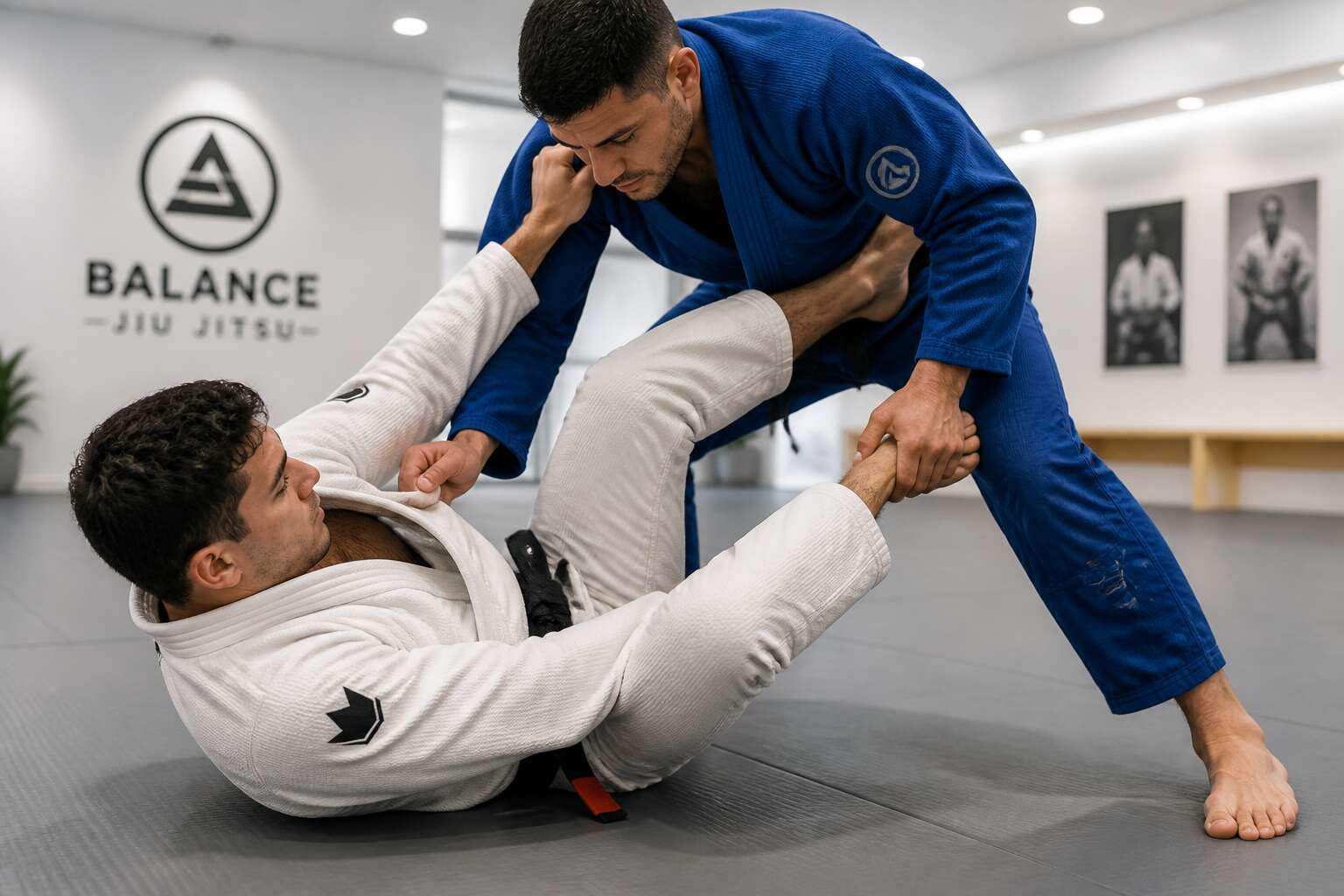
Why Jiu Jitsu Prevails in Real-World Altercations
The Ground-Fight Reality Most People Ignore
A dominant proportion of street confrontations inevitably drag participants to the ground, yet most people train exclusively for stand-up exchanges. Self defense jiu jitsu exists precisely for this overlooked reality. It transforms the floor from a place of panic into a platform for survival.
The ground neutralises physical advantages. A larger attacker loses momentum when forced to commit weight. Through drills and live rolls, you internalise responses without conscious thought.
- Submission holds end threats decisively
- Sweeps reverse dangerous positions
- Patient control prevents further violence
When your back touches the asphalt, competence replaces fear. That is the quiet victory of this discipline.
Using Biomechanics to Overcome Larger Attackers
In a confrontation where raw strength dictates outcomes, the untrained rely on adrenaline and mass. Brazilian Jiu Jitsu dismantles this premise through a simple principle: leverage. A smaller defender can manipulate a larger attacker’s balance by targeting their center of gravity, creating mechanical advantages that render physical power ineffective. This is the core of self defense jiu jitsu, a system designed for the unpredictable chaos of a real fight.
The biomechanics are profound. Gross motor skills deteriorate under stress, making complex striking combinations unreliable. Jiu jitsu, however, relies on gross motor movements like hip escapes and bridging, which remain functional when fine motor control fails. By controlling an attacker’s posture, you control their ability to generate force, effectively nullifying their size before they can use it.
Specific techniques illustrate this mastery of physics:
– The Armbar: It uses the fulcrum of your hips to hyperextend the elbow, requiring minimal strength to apply maximum pressure on a joint.
– The Kimura: This shoulder lock rotates the arm into a position where the joint’s natural range of motion is exceeded, creating immense pain and risk of injury irrespective of the opponent’s muscle mass.
– The Rear Naked Choke: It involves wrapping the neck and diaphragm, using your weight to cut off blood flow and air supply, completely bypassing the need for upper body strength.
Weight distribution is another silent equalizer. When an attacker is on top, their weight is a weapon; but the jiu jitsu practitioner uses the guard to convert this disadvantage into a trap. By working from the bottom, you use your legs to control their hips, keeping them off-balance and unable to land significant strikes while you search for a sweep or submission. This discomfort zone is familiar training ground for the grappler, but entirely foreign to the brawler, causing them to expend energy rapidly and make tactical errors.
This logical, pressure-tested approach to combat gives the jiu jitsu practitioner a distinct psychological edge. The chaos of a street fight becomes a problem to be solved, not a panic to be endured. The efficient application of these biomechanical principles means survival is not dictated by who is bigger, but by who understands the mechanics of the human body better.
Creating Distance and Exiting Safely
In Johannesburg, a street fight rarely ends with a bow. Self defense jiu jitsu teaches you to create space like you are leaving a burning braai: quickly, with purpose. The goal is not to win, but to stand up, back away, and become an anecdote. Technical standups and guard recovery are not glamorous. They are the difference between walking home and being carried. Here is the exit strategy:
– Shrimp to create hip space.
– Frame against the neck.
– Stand and circle out.
Once vertical, resist the urge to negotiate. Sprint. The only submission that matters is the one that gets you to your car. For anyone serious about self defense jiu jitsu, remember distance is a weapon. Your ego can lose; your body should not.
Critical Principles for Effective Self Defense
Posture and Base: The Foundation of Survival
A single misstep in stance can cost you everything! Under adrenaline, people stand tall and narrow, easy to shove or sweep. Self defense jiu jitsu builds a posture that refuses to be moved.
Your base connects your feet to the ground. A wide, staggered stance with soft knees gives stability without losing mobility. Your hips serve as the fulcrum for weight shifts. When an attacker pushes or pulls, your base absorbs the force and redirects it.
- Keep your chin tucked and your gaze level.
- Press your weight into the balls of your feet.
- Maintain a slight bend in your knees and elbows.
These cues feel unnatural when panic rises. Yet they separate staying upright from crashing down. I have watched students lock their knees in fear, and that error undoes every technique. In self defense jiu jitsu, posture is never static. It is a continuous adjustment of tension and release.
Priority Number One: Escaping Bottom Positions
Priority number one in effective self defense is escaping the bottom position. Once you are on your back, the fight changes. That change requires an immediate, deliberate response. Without a working escape, all other techniques become theoretical.
- Frame against the attacker’s throat or jaw to maintain distance.
- Swivel your hips to the side, never lying flat.
- Insert your knee between your bodies to create a wedge.
In self defense jiu jitsu, escaping the bottom is a skill you must own before anything else. The longer you stay horizontal, the more energy you burn. Your hips are the engine for reversal. You clear space, you shift weight, you stand up. That sequence is the difference between surviving and being overwhelmed.
Managing Space and Controlling the Clinch
In the unpredictable landscape of a street altercation, the transition from striking range to a standing entanglement is often where control is either won or lost. This is the domain of clinch control, a critical component of self defense jiu jitsu that focuses on dominating the vertical space before the fight ever reaches the ground. It is not about brute strength; it is about strategic positioning and the intelligent application of leverage.
The clinch is a dynamic conversation held at a dangerous range. Your primary objective is to establish a superior angle, breaking your opponent’s posture while maintaining your own structural integrity. This involves fighting for dominant head control and managing the space to prevent them from launching effective strikes. In this phase, you are not just defending; you are actively dictating the rhythm of the confrontation. The ability to feel and respond to an opponent’s shifts in weight is a skill honed through countless repetitions, making your reactions instinctive rather than deliberate.
Mastering the art of the clinch requires a focus on specific, high-percentage techniques. A few core concepts are essential to building this part of your game:
- The collar tie and its variations for controlling the head and neck.
- The underhook, which provides the crucial inside position for takedowns and throws.
- The pummeling motion, the continuous battle for that coveted inside control.
- Maintaining a low, stable base to resist your opponent’s attempts to move you.
These elements form the foundation of a robust standing game. When executed with precision, they allow a smaller, lighter individual to neutralize a larger, stronger attacker’s physical advantages. In the context of self defense jiu jitsu, this is invaluable. You learn to use the clinch not to engage in a wrestling match, but to create the opportunity to disengage, or to set up a precise takedown that lands you in a dominant position on the pavement. It is a critical skill for navigating the chaos of a real-world encounter, providing a measure of control in a situation that is anything but controlled.
The beauty of this strategy lies in its efficiency. A well-timed knee to the body from the clinch, or the simple act of using head control to redirect an attacker’s momentum, can change the entire trajectory of an altercation. This is where the tactical battle is often decided. By focusing on positional dominance and the constant management of space, you turn a chaotic street confrontation into a problem you can solve with structure and skill.
Protecting the Neck and Head During Chaos
The neck is the body’s most fragile column, a vulnerable conduit for signals and breath. In a chaotic encounter, the instinct to protect it is primal, yet raw panic often leads to flailing limbs and exposed gaps. Self defense jiu jitsu provides a more intelligent approach by teaching you to guard the highline while maintaining mobility. The priority is not to freeze but to position your frames, keeping elbows tight and hands high to deflect strikes aimed at the jaw or throat. This guard is active; it answers pressure with structure, turning your forearms into barriers that redirect force rather than absorb it.
To effectively shield yourself, you must adopt a defensive posture that covers multiple angles. Your chin is tucked, your shoulders are raised, and your eyes are locked on the attacker’s hips to read their intentions. This is not a static shell; it is a fluid system of checks and balances.
– The collar tie serves as an offensive guard, anchoring the head to prevent heavy punches.
– The overhook pins an arm, nullifying a primary weapon while setting up a sweep.
– The shoulder bump uses the base to disrupt balance, buying a precious second to escape.
These tactics are not just blocks; they are integrated responses that flow into the greater strategy of the ground fight. When you are forced to the pavement, the same principles apply. The goal is to prevent the attacker from gaining the dominant top position or securing a choke. You use your legs and hips to create space, constantly shrimping and framing to keep your neck off the mat and their hands away from your throat. This survival mindset, born from the repetitive drilling of self defense jiu jitsu, transforms fear into a calm, problem-solving clarity, ensuring that even in the worst-case scenario, you are always working towards a safe escape.
The Art of Sweeping and Reversing Momentum
In the swirling uncertainty of a physical confrontation, momentum is the true currency. The individual who dictates the tempo, who forces the aggressor to react rather than act, holds an invisible advantage that often proves more decisive than raw strength. This is where the deeper layers of self defense jiu jitsu come alive. It is not merely about surviving beneath a heavier opponent; it is about cultivating the sensitivity to feel their weight shift, their balance falter, and their intent waver.
This art of reversal is a study in strategic redirection. When you are pinned against the ground, the instinct to push straight upward is overwhelming, yet it is often futile. Instead, you learn to work with the force applied against you. You create angles, disrupting the stability of your opponent’s base. By capturing a limb and isolating it against your body, you transform their posture into a liability. Their aggression becomes the very lever you need to overturn the situation. It is a quiet, calculated process of turning their world upside down while yours remains firmly rooted.
To achieve this shift in control, you must master a vocabulary of movements that flow from defense to offense seamlessly. The mechanics are specific and require dedicated practice to become second nature. Consider these foundational techniques that form the cornerstone of positional reversal:
– The Bridging Sweep: Using a powerful lift of your hips to unbalance the attacker as they posture upward, allowing you to roll them over.
– The Pendulum Sweep: Swinging your legs in a controlled arc to hook their leg and topple them sideways when they shift their weight.
– The Elevator Sweep: Placing your foot into their hip and using a sharp, kicking motion to launch them over your head.
Each movement is a potential escape hatch, a way to move from a position of vulnerability to one of tactical advantage. The philosophy embedded in this training is that the bottom position is not a prison, but a platform. Through relentless drilling, these responses bypass conscious thought. When the pressure comes, your body recognizes the pattern. It does not panic; it shifts, it sweeps, and it stands. This transformation, from a state of chaos to a state of composed action, is the true hallmark of self defense jiu jitsu. It equips you with the profound confidence that you can restore order in an otherwise disordered moment.
Essential Techniques to Drill for Rapid Defense
The Hip Bump Escape from Mount
When you are pinned under a heavier attacker, time slows, and the pressure feels eternal. The hip bump escape from mount works because it attacks the assailant’s equilibrium, not their strength. You raise one side of your pelvis sharply, unseating their base, which forces them to post a hand to avoid being rolled. That sudden shift creates a window, and you must exploit it immediately by turning to your knee.
The efficiency of this escape depends on precise foot placement. You need to walk your feet in close to their hips, gaining the leverage required for a powerful bump.
– Bridge explosively onto one shoulder.
– Slide your top knee through the space they create.
– Drive your elbow into their ribs as you pivot.
The movement is a single, urgent sequence, not two separate actions. If you hesitate between the bump and the knee slide, you lose the angle. The perfect execution feels like a violent wave, ending with you on top or escaping to your feet. Drilling this with a partner who resists builds the instinctual timing that turns technique into reflex in a real altercation. The key is remembering that the bump is not for distance; it is for creating a distinct, physical opportunity in the space between your hips and theirs. This is a core building block for any practical self defense jiu jitsu curriculum.
Using the Guard to Shield and Create Angles
Most altercations end up on the ground, which makes defensive grappling non-negotiable. The guard is often your last line of defense, but holding it passively only delays the inevitable. You need a series of proactive responses to create space and reclaim a dominant position.
Your first priority is to establish a strong frame. This means forearms connected to their chest, hips off the mat, and constant movement. This is not about bench-pressing them away; it is about managing distance. When you can break their posture, you create the angle needed to attack.
Drill these core actions repeatedly until they become automatic:
– The Kimura grip: Break their posture, swim for the wrist, and threaten a submission to force them to post a hand.
– The elbow escape: Use your frame to create space, then shrimp your hips out to free your trapped leg.
– The technical stand-up: When you create a beat of space, get to your feet before they can settle back into a dominant spot.
These drills train your brain to see the opportunities between their movements. In self defense jiu jitsu, speed is less about muscle and more about timing. You are reacting to their weight shifts, not forcing a move against a static opponent.
As you drill, focus on the feel of their balance. A slight lean forward invites your sweep. A heavy base requires you to change the angle. You are not just surviving under pressure; you are learning to use their posture as a lever. That transition from defensive shield to offensive attack is where the fight turns in your favor.
The Technical Standup: Getting to Your Feet Instantly
In any physical confrontation, the ground is the most dangerous place to be. Whether you are knocked down or forced to engage from a disadvantaged position, the ability to recover to your feet is a non-negotiable survival skill. Drilling the technical standup is essential for rapid defense, but it requires specific details to be effective against a resisting opponent.
The movement begins from a seated or lying position. You must immediately turn onto your side, presenting a smaller target. Your bottom leg should slide underneath you, positioning your foot flat on the mat near your hips. Simultaneously, your top arm frames against the opponent’s neck or shoulder to maintain distance. This frame is not static; it is your primary shield against incoming strikes.
From this base, you execute the escape. Push your hips upward and drive the bottom foot into the ground. The critical moment occurs here. You must post your free hand behind you, not beside your body, to create a solid tripod base. As your weight shifts forward, you swing your top leg through and plant it behind the opponent’s lead foot. This is the tripod position.
The sequence is concise and must be practiced until it is reflexive. Follow this progression:
1. Shrimp your hips out to create space.
2. Frame against the neck to prevent head control.
3. Slide the bottom leg underneath to create a base.
4. Post the outside hand to lift your hips.
5. Swing the top leg back to establish a dominant standing base.
Once you hit that standing position, you are not safe, but you are vastly safer. You can now disengage, stand fully upright, or defend against further attacks from a superior angle. The efficiency of this movement cannot be overstated. It is faster than a full sit-out and more stable than a simple squat up. In a self defense jiu jitsu context, the standup is your return to safety.
Mastering this technique allows you to dictate the tempo. You are no longer grounded, waiting for the situation to evolve. You are actively changing the geography of the fight. The technical standup is the foundational bridge that takes you from a volatile, prone state to a stable, mobile posture. Drill it until the escape happens before your brain even acknowledges the fall.
Defending Common Street Grabs and Headlocks
The street rarely announces its violence. It comes as a clamp on your collar, a fist twisted into your shirt, a sudden arm around your neck. In those seconds, your training must answer without thought. Self defense jiu jitsu prepares you for this exact moment. You cannot outmuscle a determined grab, but you can outposition it. The following sequence should become as natural as breathing:
- Protect your throat by tucking your chin and turning your ear toward the attacker’s chest.
- Secure a high grip on the sleeve or wrist to control the pulling arm.
- Step your outside leg behind theirs to off-balance the lock.
Drill these responses until the movement feels inevitable. The headlock often follows a failed grab, so you must transition without hesitation. Shift your weight low and drive your shoulder into the attacker’s ribs, breaking the circle of their arms. This is not about flair. It is about surviving the seconds that others waste on panic.
Training Methods to Sharpen Your Survival Instincts
Integrating Strikes into Rolling Sessions
The statistic is sobering: most physical altercations begin in close quarters, often within arm’s reach. Training that ignores this reality leaves you vulnerable. In self defense jiu jitsu, we bridge the gap between sport and survival by adding striking to the chaos of ground fighting. This is where technique becomes instinct.
Positional sparring forms the core of this integration. You start in a disadvantageous position, like side control or bottom mount. Your partner applies pressure while also simulating strikes with open palms or light gloves. Your mission is to survive, escape, and reverse the situation without panicking. This drill forces you to defend your head while simultaneously working for grips and frames. It replicates the stress of a real attack.
The key lies in specific, repeatable movements. When your partner postures up to strike, their base becomes compromised. That is your window. You immediately shrimp, create space, and secure an underhook. From there, you work to a single leg or a sweep. Strikes are not just an obstacle; they are a trigger for your defense. You learn to move when they move, using their momentum against them.
– First, practice blocking strikes while maintaining your guard structure.
– Second, practice escaping as soon as your opponent’s weight shifts.
– Third, practice reversing the position immediately after the escape.
Another essential component is the stand-up drill. You begin in closed guard with your opponent throwing light strikes. Your goal is not to hold guard, but to break it, create distance, and get to your feet. This is often harder than it sounds. The urge to roll away or turn your back is strong. You must train to stay facing your opponent while rising, using a technical stand-up to protect your head. This repeated exposure builds the composure needed to survive a real street encounter.
Ultimately, the goal of self defense jiu jitsu is not to win a fight, but to escape one. By integrating strikes into your rolling sessions, you condition your mind and body to handle the violence of a genuine assault. You learn to see the openings that strikes create. You train your instincts to not just react, but to respond with a clear purpose: to get to your feet and get away. This is the reality of survival.
Simulating Adrenaline Dumps and Fatigue
Adrenaline narrows your vision and slows your fine motor skills. If you have not trained under that hormonal surge, you do not know how you will react. In self defense jiu jitsu, we simulate this response through interval drills. For example, two minutes of maximal effort escape work, followed by twenty seconds of active recovery, repeated ten times. This builds stamina while teaching you to think through exhaustion.
To sharpen your survival instincts, try this sequence:
- Mount escapes from a fresh partner every minute, no breaks.
- Guard passes against a training partner who grips your collar, forcing you to break their grips first.
- Stand-up drills where you must get to your feet and immediately shoot for a takedown.
Fatigue is where most people give up. That is why you train for it!
Selecting a Gym That Prioritizes Self Defense
Choosing a gym takes more than reading reviews. Many schools focus on sport grappling, but you need a program that drills escape and evasion under real pressure. Look for classes that include scenario-based sparring instead of purely positional rolling. A good instructor simulates ambushes and sudden attacks.
Training methods matter. Try these:
- Random attack drills from standing positions.
- Fighting from your back while strikes come in.
These sharpen your reactions beyond technique. The right environment teaches you to think while adrenaline surges. In South Africa, self defense jiu jitsu must address the realities of violent crime. Survival matters more than competition points.
Understanding the Legal Ramifications of Submissions
Training methods to sharpen your survival instincts require more than repetitive drilling. You need unpredictable scenarios where the attacker’s intent stays ambiguous. Some schools run unscripted sparring where partners launch sudden grips from blind spots. Others incorporate verbal threats before physical contact. These methods force your nervous system to process danger signals faster. The result is a composed response when self defense jiu jitsu must work outside the dojo.
Understanding the legal ramifications of submissions is equally critical. A choke applied for control is one thing. A joint lock that tears ligaments becomes a criminal matter. South African courts examine proportionality. If you continue applying pressure after the threat stops, you become the aggressor. Self defense jiu jitsu teaches restraint alongside violence. Your technique must stop the moment the attack ends.
Building a Fight-Proof Mindset Through Drilling
A sudden grip from behind. A shout before the punch. In self defense jiu jitsu, survival instincts are built through deliberate chaos. Unscripted sparring forces your nervous system to process danger signals faster. Partners attack from blind spots or add verbal threats before physical contact. The result is a composed response when the streets demand it.
Drilling must include ambiguity. The attacker never telegraphs intent. You learn to react to the first move, not the last.
- Sudden shoves during calm flow
- Grips from behind while walking
- Chokes set up mid conversation
Each repetition rewires the brain. Self defense jiu jitsu works only when the body moves before fear freezes it. Your survival instinct becomes a reflex, not a thought.
Progressive Sparring: From Resistance to Full-Contact Scenario
Most people assume self defense jiu jitsu is about memorizing a sequence of moves. They picture a clean technique applied against a willing opponent. But the streets are not a gymnasium, and a compliant partner will never simulate the chaos of a real confrontation. So how do you bridge the gap between drilling and surviving? The answer lies in a progressive training method that introduces resistance in a logical, safe, and effective manner.
Many students become proficient at executing a technique slowly and methodically. This is a necessary first step for building muscle memory. However, that proficiency often evaporates under pressure. When a training partner starts fighting back with full intensity, your carefully rehearsed mechanics can fall apart. The crucial shift happens when you begin to layer in resistance, turning a static drill into a dynamic problem-solving exercise. The goal is not to win the sparring round, but to retain the ability to think and execute technical jiu jitsu even when your body is screaming and your heart rate is spiking. This is the true essence of self defense jiu jitsu.
To build this skill, you must move through a clear progression.
1. Limited Resistance: The defender works solely on a specific escape or sweep, while the attacker holds a position without using their strength to disrupt the movement.
2. Conditional Resistance: The attacker offers moderate resistance but allows the defender to complete the technique. This helps refine the details while adding physical pressure.
3. Full Sparring with Objectives: Both partners spar with a specific goal. One might attempt to pass the guard, while the other tries to sweep or submit. This creates a realistic environment without the intensity of a competition.
4. Unrestricted Sparring: This is the final step where techniques are applied against a fully resisting partner with a focus on flow and survival, not just winning the exchange.
I have seen the benefit of this approach firsthand in our gym. Beginners often freeze when a larger partner applies pressure. It is a natural reaction. The nervous system is overwhelmed. But through repetition of these progressive stages, that same beginner learns to breathe, assess the situation, and move. The training becomes about familiarizing the body with stress so that the response is automatic. When a smaller person learns to survive against a larger, stronger opponent in a controlled sparring session, they build a confidence that is unshakeable.
This process is what separates a person who knows techniques and a person who possesses a self defense jiu jitsu skill set. It is about developing a calm mind within a chaotic body. The most effective way to achieve this is to simulate the end goal in practice. As you become more comfortable with resistance, you start to anticipate what happens when a technique fails. You learn to transition to a plan B without hesitation. This adaptability is the core of a strong guard and a solid defence. Work your way up the ladder of resistance and you will find that the body moves quicker than the mind, which is precisely what you need when survival is on the line.



0 Comments