Legal Framework of Self-Defence in Queensland
Overarching Principles of the Criminal Code Act 1899
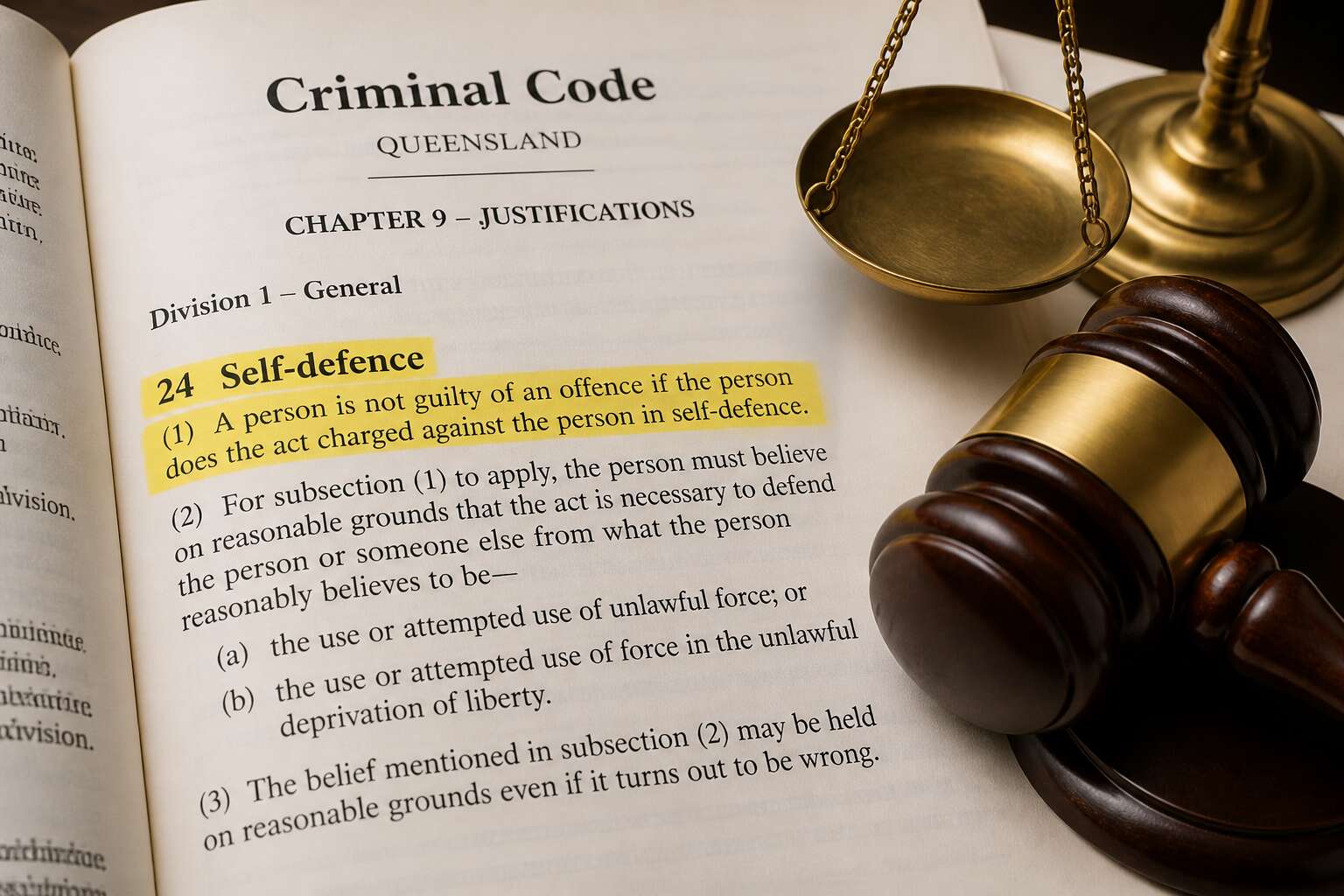
The Criminal Code Act 1899 frames self defence in Queensland as a shield, never a sword. One brutal statistic sets the stage: in a single recent year, self defence claims featured in over 200 assault trials across the state. The law demands more than a gut reaction.
For anyone wrestling with self defence qld criminal code, the statute offers a structured pathway. Section 271 anchors the law in unprovoked attacks. Section 272 deals with the messier reality of provoked confrontations. The core query is simple: did the accused honestly believe their force was necessary, and was that belief objectively reasonable?
The essential elements break down like this:
- The assault or threat must be unlawful.
- The force used must be proportionate to the perceived danger.
- The response cannot exceed what a reasonable person would consider necessary.
That subjective lens, tempered by objective reasonableness, creates real tension. The prosecution must disprove self defence beyond reasonable doubt. That is a heavy burden, and it shapes every courtroom contest. Measured responses earn protection. Overreactions do not.
Statutory Basis for the Self-Defence Provisions
The statutory basis for self defence qld criminal code rests almost entirely on two provisions within the Criminal Code Act 1899. These sections do not exist in a vacuum. They are the product of decades of judicial interpretation and legislative refinement, creating a framework that balances individual liberty with social order. Queensland courts consistently look to the precise wording of these provisions before considering any factual scenario.
Section 271 addresses the clearest situation, an unprovoked assault. Section 272 extends the protection to those who initially provoked the confrontation, though with stricter limits. Together they establish a structured enquiry for the courts.
- The accused must identify the specific provision they rely upon.
- The evidence must support a genuine belief in the necessity of the force.
- The force must align with what a reasonable person would regard as proportionate.
Understanding this statutory architecture matters. A self defence claim fails or succeeds on how well the evidence matches these legislative requirements, not on moral arguments about who started the fight.
Distinction Between Several Defence Provisions
Picture this: you are the one who started the scuffle, yet you still want the law on your side. That is exactly where the self defence qld criminal code draws its sharpest lines. Queensland does not offer a single blanket excuse; it offers a menu with different terms and conditions.
Section 271 covers the innocent soul who gets sucker punched. Section 272, meanwhile, extends a cautious hand to the initial aggressor, but only if they withdrew from the fight and said so. Then there is Section 273, which lets you defend a stranger, because Queensland apparently believes in paying it forward.
- Section 271: unprovoked assault, full protection
- Section 272: provoked assault, requires genuine withdrawal
- Section 273: defence of another person
Each provision demands a unique factual dance. The courts do not care who threw the first beer; they care whether your response matched the threat. So when you hear self defence qld criminal code, remember: it is a labyrinth, not a free pass.
Scope of the Defence and wHo Can Rely on It
The self defence qld criminal code framework is precise in scope. It applies to the use of force against a harmful unlawful act, whether directed at you or another person. The response must be proportionate and reasonably necessary in the circumstances as you perceive them. Property defence also falls under this umbrella, but with stricter limits.
Who can rely on this defence? Generally, anyone who was not the initial aggressor. If you provoked the confrontation, you lose access unless you effectively retreated and communicated your withdrawal. Acting to protect a third party also qualifies, provided that third party would have had their own right to self defence.
The courts examine:
– The nature of the threat
– The degree of force used
– Whether there were alternative options
Each element is weighed meticulously, ensuring the defence remains available to the cautious rather than the vengeful.
Limits and Boundaries of the Defence
One punch can be lawful. The next one can send you to prison. In Queensland, the self defence qld criminal code defines this boundary with precision. The defence covers force that is reasonably necessary at the instant of threat. Once that instant ends, your right to act ends with it. Any continued violence is retaliation, not protection.
I have watched courts separate genuine fear from manufactured excuses. The legal test is both subjective and objective. Your perception of danger must have been honest, and also defensible to a reasonable person. Exceed that measure and the entire defence collapses. This is where most claims fail.
The limits are precise:
- Force must be proportional to the threat
- Force must stop when the threat stops
- Retreat must be taken if it is safe and possible
The framework rejects revenge. It demands discipline at the critical moment.
When Can a Person Lawfully Use Force
Requirement of an Unlawful Assault
A single punch can alter a life forever, yet the law asks a more exacting question. When may a person lawfully use force under the self defence qld criminal code? The first requirement is an unlawful assault: an unauthorised application of force or a threat of force, without consent or lawful excuse.
The assault must be happening or imminent. A genuine perception of danger may suffice, but the person must honestly believe the threat exists. I have seen people confuse retaliation with defence, and this makes all the difference!
- Force used after the attack ends is retaliation, not self defence.
- Force used against a lawful arrest is never protected.
This first requirement keeps the defence narrow. Without an unlawful assault, the claim fails, no matter how fearful the person became.
Assessing the Imminent Threat Requirement
Imminence is the legal fulcrum upon which the entire defence teeters. A threat that has passed or not yet begun offers no lawful excuse. The precise moment of the assault’s initiation dictates everything.
To assess this, courts scrutinise the chronology with a jeweller’s eye. Consider the markers:
– Was the perceived danger contemporaneous with the response?
– Could the person have retreated safely without engaging?
– Did the force cease when the threat ceased?
The subjective belief must align with objective reality. A person who misreads a benign gesture risks losing the shield entirely. In the self defence qld criminal code, this temporal requirement separates justifiable reaction from belated vengeance. The law demands a precise alignment between fear and fact.
Test of Proportionality in Practice
Nearly every jurisdiction in Australia demands that defensive force be both “necessary” and “reasonable,” but the latter term is where the legal rubber meets the road. Proportionality is not a scientific measurement. It is a factual question for the jury, who must decide if the response was commensurate with the threat as the accused perceived it. The law does not require a perfect symmetry of force, but it does reject gross overreaction.
Consider a scenario where a smaller individual is being punched by a larger aggressor. The defender might lawfully use a weapon to repel the attack. Conversely, a trained fighter responding to a slap with a lethal strike will likely fail the test.
Courts weigh several specific factors during this analysis:
– The relative size and physical capabilities of the parties involved.
– The availability of weapons or dangerous implements.
– The number of persons on each side of the conflict.
– The duration and severity of the unlawful assault.
The central question is whether the accused honestly believed the force was necessary, and whether a reasonable person in those circumstances would have shared that belief. This dual inquiry grounds the defence in reality. If the force used was wildly disproportionate to the danger, the shield of the self defence qld criminal code evaporates, leaving the accused exposed to a full criminal conviction. Proportionality is the guardrail against vigilantism.
Degrees of Force Depending on the Level of Danger
Force is not a single, fixed measure. The law recognises that the degree of force must rise and fall with the danger. A person facing a knife attack may lawfully respond with a weapon, while a shove in a pub argument does not justify a punch to the jaw. The self defence qld criminal code allows a response that matches the threat, not one that exceeds it.
Consider the factors that shape the response:
- The severity of the harm threatened.
- The immediacy of the danger.
- Whether a lesser degree of force could have ended the threat.
Each situation demands its own calibration. The more grave the peril, the more forceful the lawful reply. But the moment the response overshoots the danger, the defence begins to crumble.
Excessive Self-Defence and Its Legal Consequences
Force becomes lawful the moment it is necessary to repel an unlawful assault. The self defence qld criminal code demands a measured response. Excess is not a grey area; it is a clear boundary. Once crossed, the entire defence collapses.
Consider a person who shoves a thief and then stomps on his head. The shove is lawful. The stomp is excessive. The consequences are serious. A charge of assault occasioning bodily harm may follow, and the claim of self defence fails entirely.
- Loss of the defence
- Potential criminal conviction
- Civil liability for damages
I have seen defendants argue that fear justified the extra blow. The courts reject that. The more excessive the force, the harsher the outcome under the self defence qld criminal code.
Defending a Home or Property in Queensland
Special Considerations for Dwelling Houses
In Queensland, the law draws a sharp distinction between defending yourself on the street and defending your castle. The place you call home triggers specific provisions that often permit a more robust response. This is where the notion of a dwelling house elevates the defence beyond a simple reaction to a threat.
For residents facing an intruder, the expectation to retreat is effectively abandoned. You are not required to weigh your options when someone has breached your threshold. The sheer violation of your private space changes the legal calculus, creating a presumption that you feared for your safety or that of your household. This recognition is crucial for anyone attempting to understand the full scope of the self defence qld criminal code provisions.
Consider the necessary force in these scenarios. The law acknowledges that a person inside their home cannot always gauge the precise level of danger with forensic clarity. Therefore, the evaluation of proportionality becomes more forgiving. The focus shifts to what you genuinely believed was necessary to end the intrusion.
– The threat within a home is often presumed to be immediate.
– The defender is typically shielded from liability for mere mistakes about the intruder’s intentions.
The shield is not absolute. The force used must still be reasonably necessary, and a court will examine whether you responded with a level of violence that was grossly disproportionate to the actual threat. Ultimately, the protection of your dwelling carries a specific weight in the self defence qld criminal code, acknowledging that a person’s home is their final sanctuary.
Protection of Personal Property Against Interference
Queensland law does not expect you to stand idle while someone makes off with your property. The protection of personal property against interference sits within a distinct corner of the self defence qld criminal code, separate from the rules that guard your body.
You may use physical force to stop an interference with movable property. That force must be reasonable, and critically, it must not extend to an intent to cause death or grievous bodily harm. The moment you intend that level of harm, the defence dissolves. This is where many misunderstand the self defence qld criminal code. Property is protected, but a life is held in higher regard.
The rules apply to movable property only:
- Vehicles
- Tools
- Livestock
- Personal possessions
Fixed fixtures and land fall under different provisions. The law treats your wallet differently from your front door. Protecting property earns some latitude, yet the boundary stays firm. A punch may be justified. A killing is not.
Trespassers and the Acceptable Use of Force
Dealing with a trespasser under the self defence qld criminal code requires a clear head. You have the right to use reasonable force to eject them from your home or property. That right is not unlimited. The force used must match the immediate threat. A person who is sitting, walking away, or running off does not justify a physical strike.
- Guiding the individual towards the exit.
- Closing and locking the door once they step out.
- Vocally commanding them to leave.
These actions are generally considered lawful. The situation changes if the trespasser turns hostile or produces a weapon. At that point, stronger defensive measures become permissible. But once the threat ends, the right to use force also ends. Striking a trespasser who has submitted or who is retreating is not self defence. It becomes an act of retaliation, which the criminal code does not excuse.
Scenario-Based Applications of Home Defence Rules
Imagine a stranger forcing a window at 2 a.m. and stepping into your living room. The self defence qld criminal code permits you to meet that immediate threat with force. But the law shifts the moment the intruder halts or raises their hands. Continued violence after submission is retaliation, not defence.
Consider a different scene. Someone wheels your motorcycle out of the gate. Property alone does not justify a lethal response. The code requires a threat to a person, not just possessions. You may use physical force to protect your property only where an unlawful assault is happening or imminent.
Common lawful options include:
1. Issuing a clear verbal challenge.
2. Blocking the offender’s path without striking.
3. Using minimal restraint until police arrive.
Every scenario hinges on immediacy and proportionality. The self defence qld criminal code provides no blanket immunity for guardians of property.
Proving the Defence Before a Court
Legal Burden and Evidentiary Requirements
The burden in a Queensland court might feel counterintuitive for the accused. While the prosecution must ultimately disprove the defence, the person raising it must first point to credible evidence. This is the evidential burden, a threshold that forces the defendant to show a genuine factual basis for their claim. Without this foundation, a judge will not allow the jury to consider the application of the self defence qld criminal code provisions at all.
This evidentiary requirement is not about proving innocence, but about creating a legitimate legal question. The evidence can come from the defendant’s testimony, witness accounts, or forensic material. It must suggest the accused honestly believed the force was necessary and that a reasonable person would have shared that belief. The evidence might include:
- Witness statements confirming the aggressor’s movements.
- Photographic evidence of injuries or damage to property.
- Expert testimony on the nature of the threat faced.
Once this threshold is met, the legal burden shifts. The prosecution must then convince the jury beyond a reasonable doubt that the accused was not acting in self defence. In practice, this creates a delicate interplay. A defence lawyer cannot simply rely on the weakness of the prosecution’s case; they must actively introduce material to satisfy the judge. If the evidence is too thin, the matter never reaches the jury, and the trial effectively collapses for the defence. This is the technical gatekeeping that determines whether a fight over the self defence qld criminal code actually happens in court.
Key Evidence Needed for a Successful Claim
In the stark theatre of a Queensland courtroom, strategy often matters more than spontaneity. The moment a defendant raises the self defence qld criminal code provisions, the focus shifts from the attack itself to the corroborating details that support their account. Presenting a bare assertion to a jury is insufficient; the defence must construct a scaffold of objective proof from which the jury can logically infer a genuine belief in the necessity of force.
The presentation of this evidence is a deliberate choreography. It involves a careful sequencing of material designed to reconstruct the defendant’s perception of the threat. Consider the components that often form the backbone of a credible claim:
– The immediate context of the confrontation, including the verbal threats uttered by the alleged aggressor.
– Physical evidence such as torn clothing, defensive wounds, or the position of a weapon at the scene.
– Medical records documenting the extent and location of injuries, which might indicate a struggle at close quarters.
– The historical relationship between the parties, demonstrating a pattern of prior aggression.
Digital evidence has become equally pivotal. Mobile phone footage, social media messages, and GPS data can place individuals at specific locations and reveal the aggressive intent of the deceased or complainant prior to the incident. By weaving together these threads of documentation and testimony, the defence meets the evidential threshold. A failure to do so means the judge withdraws the self defence qld criminal code question from the jury’s consideration, leaving the accused to face the full weight of the prosecution’s narrative without a legal shield.
Role of Witness and Expert Testimony
The cool air of a Queensland courtroom carries the weight of memories, not just of the incident, but of lives lived in the shadow of fear. Proving a claim under the self defence qld criminal code often hinges on the quiet authority of those who observed the patterns. A neighbour who witnessed months of escalating harassment, a colleague who saw the fresh bruises before they faded, these voices provide the context a jury craves. I have watched a defendant’s shoulders relax slightly when a familiar face confirms the terror they felt was real.
Witness testimony, however, is only part of the mosaic. The expert’s role is to translate the chaos of a violent struggle into a clinical language the court can trust. A forensic pathologist might map the trajectory of a wound, while a psychologist explains the hypervigilance born from chronic abuse. Their analysis is dispassionate, yet it breathes life into the abstract legal tests of reasonableness. Without this professional scaffolding, a compelling narrative remains just a story.
The choreography of this testimony is deliberate, a sequence designed to build a wall of credibility.
– The lay witness establishes the history of threats and prior aggression.
– The medical expert correlates the injuries with the accused’s account of a close-quarters fight.
– The digital analyst verifies the timeline, placing the accused in a position of perceived peril.
Each element reinforces the others. The court does not demand certainty, only a logical inference that the force used was a rational response to a genuine threat. When the testimony is seamless, the defence transforms from a claim into a documented reality. The final question of guilt or innocence rests not on what happened, but on how convincingly the fear and the response are reconstructed for those who must judge. The self defence qld criminal code offers the legal door, but only the witness and the expert can provide the key. In my experience, the most persuasive defence lawyers are those who understand this human geometry of proof.
Consideration of Prior Conduct and History Between Parties
In a self defence qld criminal code trial, the court does not judge a single moment in isolation. It examines the relationship between the parties, the pattern of behaviour leading to the clash, and the unspoken narrative written over months or years.
Prior conduct can shift the interpretation of an accused person’s fear. A history of threats from the deceased or a record of mutual aggression changes the reasonableness calculus. Judges scrutinise whether the accused was the first aggressor or the persistent target.
- Previous physical or verbal threats
- Prior altercations between the parties
- Patterns of stalking or intimidation
- Any documented protection orders
This history is not background noise. For anyone facing charges, the question of who did what to whom long before the final violence often becomes the fulcrum of the defence. The self defence qld criminal code gives weight to this context, but only when the evidence is placed before the court early and clearly.
How a Magistrate or Jury Evaluates the Claim
A single moment of violence, once frozen in time by a charge sheet, becomes a fluid narrative in the courtroom. The presentation of evidence transforms the incident from a stark snapshot into a moving picture. How does a magistrate or jury actually weigh a claim of self defence qld criminal code when the dust has settled and the only truth available is the one assembled from fragments?
The process is not a search for absolute clarity, but an assessment of credibility. The prosecution builds a case for aggression, while the defence must plant a seed of reasonable doubt regarding the accused’s perception of danger. This is a subtle alchemy. The court looks for a coherent timeline, one where the accused’s actions logically follow their stated fear. Bravery is not the benchmark; humanity is. The question becomes whether a person with a comparable history and mindset would have done the same under the same apparent threat.
Several core elements often anchor the evaluation:
– The credibility of testimony, considering the demeanour and consistency of the witness.
– The forensic evidence, which acts as an impartial arbiter of positions and movements.
– The timing of responses, particularly whether the accused reacted instantly or after a pause that suggests deliberation.
The jury or magistrate weighs these elements against the statutory thresholds of imminence and proportionality. There is no formula for this. It is a human judgement call made under pressure, a decision that relies on the subtle art of sensing whether the threat described by the accused feels genuine, or merely convenient. This intricate evaluation is the true test of the self defence qld criminal code, where the abstract law meets the gritty reality of human fear. Ultimately, the bench must decide if the force used was a reflection of a genuine threat, not an excuse, and whether the retaliation was commensurate with the peril as it was perceived at that exact, irrevocable moment. The standard is one of a reasonable person placed in that same firing line, not a jurist sipping water in a cool courtroom.
Common Pitfalls That Undermine the Defence
Title: Self Defence Qld Criminal Code and the Delicate Balance of Justifiable Force
Understanding the self defence qld criminal code provisions requires an examination of how the law weighs human instinct against social order. The legal framework does not demand passive victimhood, but it also refuses to sanction vigilantism. The core inquiry in any trial is whether the accused’s actions, taken in a moment of perceived peril, were a reasonable and proportionate response to the threat as they perceived it.
The foundation of this defence rests on the subjective perception of the accused. The law acknowledges that a person under threat cannot weigh options with the detached precision of a scholar. They may act on instinct, driven by the primal need for survival. However, perception alone is insufficient. The Criminal Code insists that the response must also be objectively reasonable. This dual test is the central tension in the courtroom, separating a lawful act of preservation from a criminal act of aggression.
The Statutory Framework and the Threshold of Imminence
The legislative structure provides a statutory excuse for the use of force in specific circumstances. It covers the defence of oneself, the defence of another person, and, under certain conditions, the defence of property. The excuse is not a blank cheque for violence. It is a precisely worded allowance that hinges on the necessity of the act. The person must believe, on reasonable grounds, that they cannot preserve themselves from harm except by using the force they employed.
A critical element in the assessment is the concept of imminence. The threat cannot be a vague, future possibility. It must be present and pressing, or at least believed to be so on reasonable grounds. This requirement is frequently the dividing line between a successful plea and a conviction. The timing of the act is therefore under intense scrutiny. Did the accused strike during the assault, or did they pursue the perceived aggressor after the immediate danger had subsided? The magistrate or jury must place themselves in the accused’s shoes at the exact moment of the incident.
How the Court Evaluates the Proportionate Response
When the matter proceeds to a trial, the evidence presented must reconstruct the chaos of the confrontation. Witness testimony, forensic analysis, and surveillance footage are pieced together to create a coherent timeline. The court examines the nature of the initial threat. Was there a weapon involved? Was there a significant disparity in size or physical capability between the parties? These factors influence the judgment on whether the level of force used was excessive.
The law does not require a perfect, measured response. It allows for the “heat of the moment” and the confusion that accompanies a sudden attack. Yet, there is a distinct boundary where self-preservation ends and unlawful punishment begins. If the accused continued to strike an incapacitated assailant, or if they used a weapon when a lesser degree of force would have neutralised the threat, the defence of the criminal code will likely fail. The degree of force must be calibrated to the perceived danger, not to a desire for retribution.
The Burden of Proof and the Role of the Jury
The evidentiary procedure places a specific burden on the accused. They must first raise the evidence of self-defence. Once raised, the prosecution assumes the responsibility of disproving the defence beyond a reasonable doubt. This is not a burden of proof resting on the defendant; it is the prosecution’s duty to convince the fact-finder that the actions were not justified.
The assessment of the accused’s state of mind is a nuanced process. A jury does not simply ask, “Was the force excessive?” They ask, “Was this a reasonable person’s belief in these specific circumstances?” The witness stand offers a platform for the accused to explain their fear. However, the credibility of that explanation is measured against the objective facts. A claim of fear that is contradicted by the physical evidence of the injuries inflicted, or by the testimony of impartial bystanders, will be viewed with suspicion.
The Enduring Question of Reasonable Belief
Ultimately, the success of a plea under the self defence qld criminal code is a matter of applying human judgment to legal principle. It is an attempt to codify the instinct of survival into a workable rule. The court acknowledges that a person facing a violent confrontation is not acting in a vacuum. They are reacting to a dynamic situation that is evolving by the second. The legal process, with the benefit of hindsight, must determine whether that reaction was within the bounds of acceptable human behaviour.
The outcome of any case depends on the specific facts, the quality of the evidence, and the interpretation of the law by the presiding judge and the jury. It is a system that relies on the collective wisdom of the community to discern the difference between a tragic necessity and an unlawful act. The law does not celebrate violence, but it recognises the fundamental right to exist and the inherent right to defend that existence. This delicate balance is the heart of every self-defence trial.
Misunderstandings and Consequences of Defensive Force Claims
Whether a Duty to Retreat Exists
One persistent misunderstanding is that Queensland law compels a retreat before any defensive force. The self defence qld criminal code actually permits a person to hold their ground, provided the response is reasonable. Yet this subtlety is often lost on those who rely on hearsay rather than the statute.
The consequences of this error are not academic. A claim can collapse when a court finds you had a safe route to withdraw and did not take it. On the other side, retreating when unnecessary can leave you defenceless. Common misunderstandings include:
- the belief that retreat is always obligatory
- the assumption that any force becomes lawful once threatened
- the idea that prior verbal threats alone justify a preemptive strike
Each mistake skews how a jury weighs your state of mind. The law rewards a clear assessment of danger, not a blind reaction.
Engagement in Mutually Consented Confrontations
Mutual consent to a confrontation dismantles many assumptions about self defence. The self defence qld criminal code demands an unlawful assault before force can be justified. When both parties voluntarily engage in a fight, neither faces an unlawful assault, so a later claim collapses. Some people believe that winning the exchange matters, but the statute focuses on who initiated and whether withdrawal was genuine. If you agreed to fight and then stepped back, you must say so clearly.
- Your credibility is questioned from the outset.
- The defence becomes unavailable.
- You face liability for assault despite any injuries taken.
These outcomes are not theoretical. I have seen the law punish those who misread consent as a legal shield. Retreat must be explicit and sincere!
Impact of Being Intoxicated at the Time of the Incident
Intoxication strips away the measured judgment that the self defence qld criminal code assumes you possess. A blood alcohol level does not transform a slurred insult into an unlawful assault. When you claim defensive force after a few drinks, the court examines whether your belief in the threat was reasonable. A drunken misperception rarely meets that bar.
Your own conduct becomes the focus. Did you initiate the exchange? Did you sway into a brawl? The consequences cascade. Your credibility diminishes, witnesses recall your erratic posture, and the prosecution highlights your impaired awareness. Consider what happens to a defensive claim under intoxication:
- The honest belief is accepted only if a reasonable sober person would share it.
- Voluntary intoxication never excuses excessive force.
- A court may infer you were the aggressor based on your behaviour.
The impact is brutal. Your claim collapses not because the threat was absent, but because your perception was clouded. The law does not reward a foggy filter.
Potential for Civil Proceedings After a Criminal Case
A successful criminal defence does not end the story. Even when a court clears you under the self defence qld criminal code, a civil lawsuit can follow. The victim or their family may sue for damages. Criminal and civil proceedings operate independently. An acquittal does not bar a civil claim. The burden of proof is lower in civil court. I have watched clients underestimate this risk.
Misunderstandings arise when people assume a not guilty verdict protects them. It does not. A civil court can reach a different conclusion using the same facts. Your legal costs double. Your reputation suffers. The self defence qld criminal code shields you from criminal punishment, but not from financial liability. That misconception can be costly!
Consider these points:
- Civil courts assess reasonableness on a balance of probabilities.
- Your criminal defence strategy may expose you to civil discovery.
- Insurance rarely covers intentional torts.
This is not a remote risk. Many defensive force claims fail in civil court. You need separate legal advice from the start.
Interaction With Other Defences Such as Duress
A mistaken belief in a defensive claim’s strength can have lasting financial and legal effects. People often confuse the self defence qld criminal code with other defences, particularly duress. Duress relies on an external threat of death or serious harm, while self defence focuses on an unlawful assault. Misapplying these distinct legal tests destroys an otherwise valid defence.
The consequences of such confusion are severe. If the claim fails, you face a criminal conviction and a likely civil lawsuit. Consider these frequent misunderstandings:
- Assuming duress can justify actions outside its narrow scope.
- Believing a proportionate response is unnecessary if you feel threatened.
- Thinking that a mistake of fact always excuses excessive force.
Each error weakens your position in court. The interaction between defences is complex, no matter the jurisdiction. A successful outcome depends on correctly applying the specific rules of the self defence qld criminal code, not just claiming your life was in danger.




0 Comments