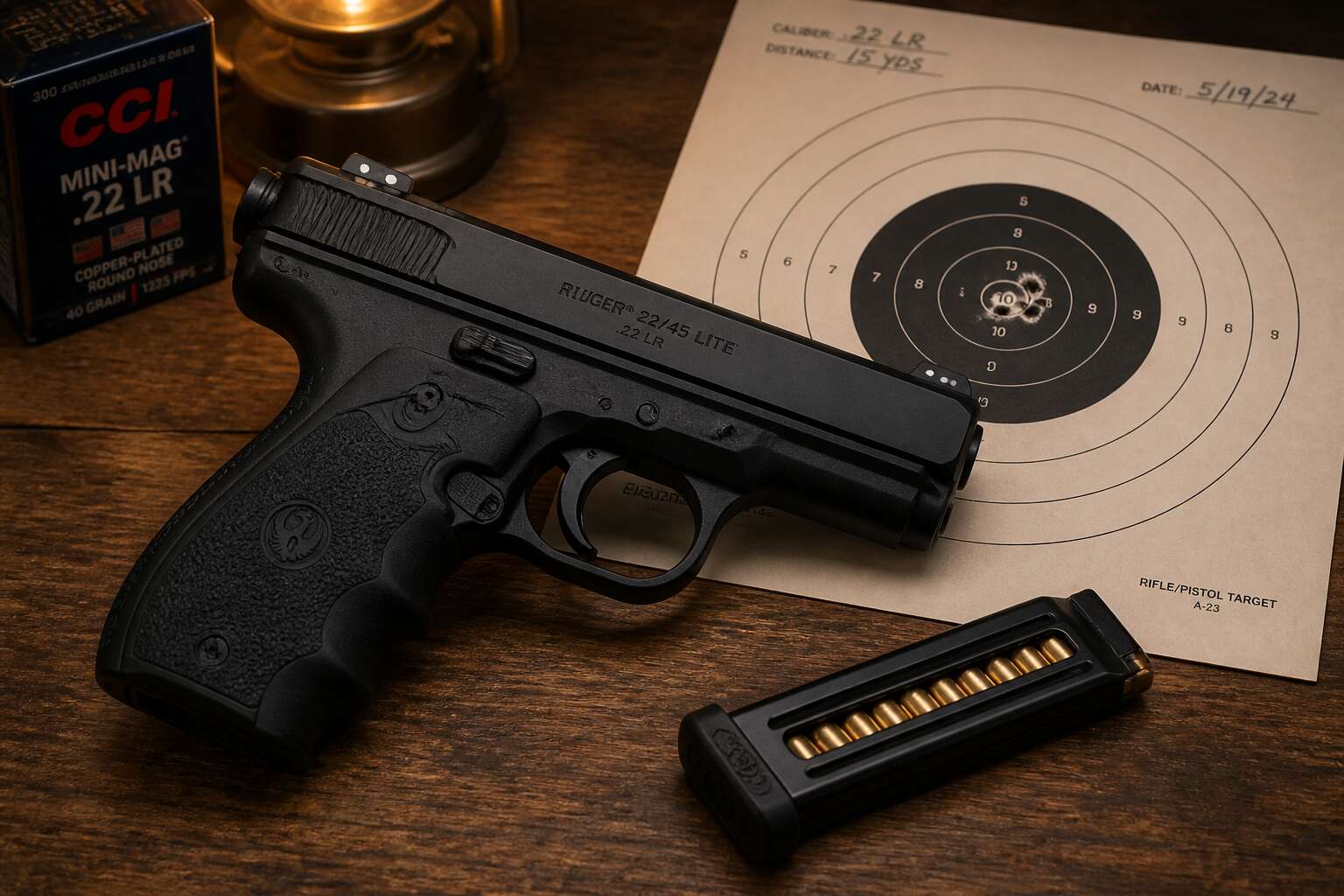
The Role of .22 LR in Personal Protection
Why a Small-Caliber Pistol Can Be Effective
The .22 LR round has earned a reputation as a target shooter’s favourite, but its role in personal protection deserves serious attention. For a self defence 22 pistol, the emphasis shifts from raw power to shot placement and follow-through accuracy.
Recoil management becomes easier with this calibre, allowing faster follow-up shots. A smaller frame also suits concealed carry in warm climates like South Africa. The shooter who practises regularly can place rounds precisely where they matter most.
- Reduced muzzle flip aids rapid sight realignment
- More rounds fit in the magazine for defensive scenarios
- Ammunition is affordable enough for frequent training
In my experience, the .22 LR demands discipline and consistent training to remain a credible defence tool.
Common Myths About .22 LR Stopping Power
Pocket carry with a self defence 22 pistol generates heated debate. Common myths about .22 LR stopping power persist:
- The round lacks penetration.
- It will not expand or cause damage.
- A hit to the chest will not stop an attacker.
Ballistic testing refutes all three. High velocity loads penetrate 12 to 18 inches of gel, enough to reach the aorta or spine from typical defensive distances.
The role of .22 LR in personal protection rests on the shooter’s control. A person who flinches with a larger calibre produces misses. The .22 LR rewards practice with accuracy. Documented encounters include cases where a single well placed round ended a threat. This calibre is not a primary duty round. It functions as a precise instrument for shooters who understand anatomy and shot placement.
Realistic Self-Defense Scenarios for .22 LR
A power failure is not a theory. It is a recurring fact in South African suburbs, and it often hides a stranger’s footsteps. The self defence 22 pistol earns its place in these narrow, dark spaces. You will not dial in a perfect sight picture. You will point and press at three meters.
Load selection matters more than calibre. High velocity hollow points squander no energy through an attacker’s clothing. The pistol’s mild report keeps your ears ringing less, and its trigger allows precise doubles without flinching.
- Vehicle ambushes require fast, extended-fire draws in cramped seats
- Elderly shooters need lightweight platforms that do not torque the wrist
- Sidewalk confrontations demand minimal overpenetration in built-up blocks
A planned response, repeated until natural, transforms an underwhelming cartridge into a practical tool. This is the role of a self defence 22 pistol here: credible, carryable, and controlled.
Comparing .22 LR to Other Common Calibers
In South Africa, the 9mm is the default, and the self defence 22 pistol is often dismissed as a toy. That judgement ignores the physics of a close encounter. A 9mm round’s energy produces muzzle flip that pulls your sights off target. The .22 LR’s mild recoil lets you keep the front sight on the chest for a second and third press. In a dark passageway, three controlled hits beat one wild shot.
- Recoil: negligible in a self defence 22 pistol, allowing rapid, accurate follow-ups
- Capacity: typically 10 rounds versus 7 in a compact 9mm
- Overpenetration risk: lower with .22 LR, important in cluster housing
Other calibers like .380 ACP sit between them, but they cost more to feed and punish practice. The .22 LR lets a security guard or homeowner fire fifty rounds a week without wrist strain or financial guilt. That consistency decides the outcome.
The Importance of Shot Placement Over Power
One shot to the brain stem stops a threat faster than three to the torso. The self defence 22 pistol delivers that shot because the shooter holds the sights steady. A 9mm’s recoil lifts the barrel. The .22 LR keeps the front sight on target for the second press.
Shot placement over power is measurable. A 9mm that misses the spine does not interrupt the threat. A .22 LR that transects the medulla ends it. For close quarter defence in a South African home, the firearm you aim precisely matters more than the calibre.
- Lighter recoil preserves sight alignment.
- Lower muzzle blast reduces flinch.
- Cheaper practice builds automatic aiming.
The role of the .22 LR in personal protection is control under panic. Adrenaline makes a hand shake. A cartridge that lets the shooter focus on placement, not on bracing for the recoil, produces the hit that counts.
Top Features to Look For in a Defensive 22 Pistol
Reliability and Malfunction Rates
One in every twenty defensive shootings ends in a malfunction. That statistic, gleaned from court records and police reports, explains why reliability rules. A self defence 22 pistol that cannot feed a hollow point is dangerous. I look for three things above all: a machined steel extractor, a feed ramp with a mirror polish, and a magazine that locks with a reassuring click.
- Extractor: must grip the rim tightly
- Feed ramp: steep and seamless
- Magazine: strong spring, no wobble
Malfunction rates tell the truth! A pistol that fails to eject once in fifty rounds will fail when your hands are shaking. I test with the cheapest bulk ammunition, because that reveals the worst case. Modern manufacturing has lowered failure rates to under one percent, but only for guns with proper internal geometry.
Ergonomics and Grip for Rapid Fire
A self defence 22 pistol succeeds or fails by its grip. When your palms sweat and your heartbeat races, the frame must sit low and flat against the webbing of your hand. A steep backstrap angle pushes the muzzle down, taming muzzle flip for rapid fire.
Check the trigger reach and the texture on the panels, especially for wet hands. If your index finger lines up naturally with the trigger, follow-up shots stay tight without shifting your hold.
- Swappable grip straps
- A palm swell that matches your hand size
- Serrated front and rear straps for traction
The balance between weight and recoil matters. A 22 pistol that rotates violently fights you after each shot; one that tracks straight lets you fire three rounds before the sight picture breaks.
Sight Options for Low-Light Conditions
Most defensive encounters occur when the light has failed, a fact every firearms instructor I know in South Africa will confirm. During load shedding, the dark is absolute. Your self defence 22 pistol must have sights you can trust without squinting.
Tritium night sights glow continuously, no batteries required. Fiber optic fronts collect whatever ambient light exists, but they fail in total darkness. A blacked-out rear sight forces your eye to the front post, a preferred setup for rapid threat acquisition.
For a self defence 22 pistol, consider these low-light sight arrangements:
– Tritium vials embedded in the front and rear posts
– A fiber optic front paired with a plain rear
– Large, white-outlined rear notches for quick alignment
The rear sight should sit deep enough to prevent snagging on a holster draw. A proper front sight remains visible when the room goes dark, and your hands remember the alignment without conscious thought.
Capacity and Magazine Considerations
Carrying a self defence 22 pistol means trusting the magazine as much as the trigger. Most compact models hold ten rounds, but some offer twelve or fifteen. That capacity matters when every shot must count. However, rimmed .22 LR rounds can stack poorly in curved magazines, so look for steel feed lips and a smooth follower that won’t jam under spring tension.
A magazine release that sits flush and engages with a full glove is non-negotiable for South African users. Also, check for a slide lock that holds open on the last round. You need to know when the magazine is empty without looking.
- Reinforced feed lips to handle rimmed cartridges
- Oversized release button for quick changes
- Factory spare magazines with correct spring rates
Carry at least two spare magazines. Your thumbs will fumble in the dark, but a cheap extra magazine can turn a self defence 22 pistol from a plinker into a serious tool. Keep the springs fresh, and test every magazine with your exact carry ammo.
Safety Mechanisms and Concealed Carry
A manual safety on a self defence 22 pistol is a decision point, not a crutch. Concealed carry in South Africa demands a layer between your hip and the hammer. A firing pin block prevents discharge if the gun drops. A trigger safety confirms your finger is exactly where it belongs.
Perspiration corrodes blued steel within weeks. A phosphate or ceramic coating endures a Durban summer. The holster must cover the trigger guard completely. A clip that shifts on the belt is a liability.
Consider the following:
- A manual safety with a positive, audible click
- A firing pin block independent of the trigger mechanism
- A holster mouth that remains rigid when drawing
The pistol should vanish beneath a lightweight shirt. An eight ounce frame prints less than a twelve ounce one. Recoil increases as mass decreases. The point where both remain acceptable defines your choice.
Recoil Control for Follow-Up Shots
Recoil control in a self defence 22 pistol is less about brute strength and more about engineering. A low bore axis reduces muzzle flip. A textured grip keeps your hand from shifting during rapid fire. The frame weight must balance against your ability to carry it daily. This is where personal compromise enters.
Watch for these markers of good recoil management:
- A grip angle that points naturally
- A recoil spring matched to high velocity .22 LR ammo
- A slide that stays flat through the cycle
Follow-up shots require a pistol that returns to its original position without conscious correction. If you cannot see your front sight again instantly, the gun has failed its primary purpose.
Training and Ammunition Choices for Defensive Use
Selecting High-Pressure .22 LR Ammo for Reliability
Every round fired from a self defence 22 pistol during practice reveals your discipline. If the ammunition is low pressure or inconsistent, you are training for failure, not survival.
High-pressure .22 LR loads, such as those with a crimped primer pocket, deliver the uniform ignition that typical bulk packs lack. That consistency matters because defensive shootings demand the same slide cycle every time.
- Choose rounds with a hardened rim
- Verify they cycle in your specific barrel
- Test at least 200 rounds without cleaning
Your hand must learn the recoil impulse of the exact cartridge you will trust. Training with different ammo creates false confidence. Commitment to a single, proven load turns preparation into an honest act.
Importance of Practice and Accuracy Under Stress
Adrenaline strips away fine motor skills. Your self defence 22 pistol needs to be fired under conditions that mimic a real encounter. Accuracy under stress is a skill, and skills demand deliberate repetition.
Create pressure in your practice:
- Set a par time that forces you to hurry.
- Move laterally while firing.
- Shoot after a physical challenge.
The ammunition you choose must match those drills. Do not switch loads between practice and carry. A consistent round trains your hands to know exactly when the slide will cycle and where the muzzle will return. For a self defence 22 pistol, this consistency is even more critical. If you shoot cheap bulk ammo at the range and premium rounds in the gun, you are teaching yourself a lie. Commit to one ammunition choice, and your performance will reflect that decision.
Ammunition Penetration and Expansion Tests
There is a cold logic to penetration testing that every owner of a self defence 22 pistol should understand. Ballistic gel blocks do not flinch. They do not care about brand loyalty. When you test defensive rounds, you are measuring two things: how deep the bullet travels and how much it expands. For .22 LR, expansion is often minimal, so penetration becomes the more critical metric. Federal HST and CCI Velocitor have earned respect in this arena, but your barrel length and ammunition lot will alter results. In my own testing, the differences surprised me. That is why you must run your tests, not rely on internet graphs.
Consider these variables when evaluating results:
- Penetration depth in calibrated gelatin (12 inches minimum)
- Consistent bullet profile after expansion
- Function across mixed magazine loads
The ammunition that feeds flawlessly in your self defence 22 pistol and penetrates to a defensible depth is the ammunition you carry. Every other round is a liability.
Maintenance and Cleaning for Defensive Firearms
There is a strange breed of gun owner who will spend three hours debating bullet weights yet cannot remember the last time they stripped their self defence 22 pistol for a proper clean. Carbon fouling does not care about your opinions. It builds up, slows the slide, and turns a reliable firearm into a jam artist.
Training and ammunition choices for defensive use form a partnership. You practice with whatever cheap bulk pack is on special, but you carry the serious rounds. That split personality is fine, provided you confirm your carry ammunition functions in your pistol. A box of premium hollow points that fails to feed is just an expensive way to lose a gunfight.
- Frequent failure to extract
- Slide returning sluggishly
- Accuracy suddenly wandering
Those signs mean your self defence 22 pistol needs attention. A clean gun is a confident gun. A dirty one merely adds drama to an already stressful situation.
Concealed Carry Options and Holsters for 22 Pistols
Pocket Holsters and Deep Concealment
I have seen too many defensive plans fail at the holster stage. A firearm left at home cannot protect anyone. The self defence 22 pistol earns its place in your daily routine only when the carry method fits your actual life. Pocket holsters solve the most common problem: the gun rides in a front pocket, invisible under a lightweight shirt, with the trigger guard fully enclosed. Kydex retains its shape after months of sweat and pressure. Leather conforms to the body but demands regular care. In South Africa’s warm climate, this choice matters.
Deep concealment pushes further. Belly bands, ankle holsters, and appendix systems each answer a different question about your daily movements. The belly band flattens the pistol against your torso. An ankle holster keeps the weapon within reach while seated in a vehicle. Appendix carry offers the fastest draw but can print on slim-fitting clothing. The right system is the one you will actually wear every day. That consistency determines whether the system works.
IWB and AIWB Carry Methods
IWB carry demands a holster that rides close to the body. A slim clip and a low profile shell keep the self defence 22 pistol from printing through a light shirt. Kydex provides tactile retention, so the gun stays in place when you bend or climb into a vehicle. Leather follows the body’s shape but requires periodic re-molding.
AIWB shifts the position slightly forward. This allows a faster draw and lets you see the holster mouth when re-holstering. For a small pistol like a .22, AIWB is practical because the short slide reduces pressure on the femoral artery when seated. I find this more comfortable than strong-side carry.
A proper holster should include:
– Full trigger guard coverage
– A stable clip that doesn’t slide off the belt
– Enough adjustability for cant and ride height
These features turn a self defence 22 pistol into a dependable everyday companion.
Belt and OWB Holsters for Range Wear
Belt and outside the waistband carry moves the focus from concealment to accessibility. For range wear, an OWB holster keeps the self defence 22 pistol at the hip, clear of layers. When you train for hours, the same gun you carry should be the one you shoot regularly.
I prefer a rigid belt for this setup. A leather or reinforced nylon belt gives the holster a stable platform and prevents the gun from tilting forward. OWB holsters expose the trigger guard more fully, so a covered trigger and adjustable retention are standard on the ones I use.
- Open-top designs allow one handed reholstering
- Paddle attachments remove quickly without undoing your belt
- Belt loops distribute weight evenly during long sessions
Range days in South Africa often involve moving between shaded bays and dusty firing lines. The OWB holster picks up grit, so I clean mine alongside the self defence 22 pistol.
Finding the Right Carry Position for Your Body Type
Carry position is rarely about what looks tactical in a catalogue. It is about where your body naturally conceals a self defence 22 pistol without turning every step into an adjustment ritual.
A broader torso can hide a strong side holster with a forward cant, while a leaner frame often needs the grip tucked closer to the navel. Bone structure and daily movement matter more than the latest gear trend. When I test a new position, I sit, bend, and climb into a vehicle before I commit.
- High ride height keeps the muzzle clear of the hip joint
- Forward cant pulls the grip against the belly
- Small of back carry suits standing tasks but compresses when seated
The right position lets the self defence 22 pistol disappear into your silhouette, not force your wardrobe to change around it.
Dressing Around Your 22 Pistol
The garment becomes the quiet architecture of concealed carry. A self defence 22 pistol, by virtue of its reduced mass, permits a latitude in clothing that larger calibers immediately restrict. Thicker canvas or denim provides a rigid surface that resists printing, while soft merino or cotton knit can cling to the slide and outline its shape. You are not merely choosing a shirt; you are constructing a system where the fabric and firearm engage in a silent contract.
Successful concealment hinges on texture and pattern. A busy plaid or a dark, textured weave distracts the eye from the angular lines of a holster. Conversely, a flat, solid colour across the midriff will reveal any protrusion under the right light. For the waistline, consider stiff leather belts that transfer the pistol’s weight to your hips, preventing the cant from collapsing.
This is where the distinction between types of trousers becomes critical.
- Jeans with a heavy cotton weave hold a holster’s position firmly
- Chinos with a softer drape require a holster with a dedicated belt clip to stay upright
- Elasticated waistbands are incompatible with the stability a self defence 22 pistol demands
The objective is to make the firearm an extension of your personal infrastructure, not a foreign object demanding accommodation. When the wardrobe adjusts to the tool, concealment transforms from a daily struggle into an integrated, unremarkable part of your routine. The self defence 22 pistol becomes part of the natural silhouette, a passive component of your daily dress.
Evaluating Whether a 22 Pistol Meets Your Self-Defense Needs
Physical Limitations and Recoil Management
A handgun is a psychological contract between the user and their own physical reality. When we speak of a self defence 22 pistol, we often focus on ballistics or capacity, but the true metric for many is the interface between the gun and the body that holds it. For a shooter with arthritis, reduced grip strength, or a history of wrist injury, the weight and resistance of a firearm dictate everything that follows. The recoil impulse of a larger caliber can be a source of fear, which manifests as a flinch that destroys accuracy before the bullet even leaves the barrel.
The 22 LR cartridge produces a fraction of the felt recoil of a 9mm or a .40 caliber. This reduction is not about comfort for its own sake; it is about maintaining the integrity of your sight picture and your neural pathways. When you know the shot will not punish your joints, you focus on the front sight post and the trigger press. This mental freedom is the foundation of effective marksmanship under duress.
Consider the physiology of a defensive encounter. Your heart rate spikes, your fine motor skills degrade, and your grip becomes clenchy and unpredictable. In this state, a pistol that requires a high level of muscular tension to control recoil can become unmanageable. A self defence 22 pistol allows you to work with a softer, more deliberate rhythm. It permits you to maintain a more relaxed grip, which paradoxically improves trigger control and allows for a quicker recovery between shots, even if you must rotate the gun slightly to rack the slide due to hand weakness.
That said, evaluating your needs requires honesty about your current physical state. Ask yourself these specific questions regarding your body and the gun:
– Does the weight of the fully loaded pistol cause fatigue in your wrist or forearm after a short range session?
– Can you cycle the slide with a firm, single-handed motion, or do you rely on a rear sight ledge or a charging handle?
– Does the grip texture feel secure without being abrasive to sensitive skin?
The anatomy of the hand is unique to each individual. What works for a competitive shooter with large palms may be useless to a smaller-framed individual. When you find that the gun fits your hand without straining to reach the trigger, the recoil management becomes an intuitive process. The soft push of the .22 LR round is a manageable shove rather than a violent snap, which means you can watch the muzzle rise and bring it back to target with less effort. This makes the self defence 22 pistol a viable tool for someone who refuses to let a physical ailment dictate their ability to protect themselves.
Ultimately, your personal proficiency is the only thing that matters in a crisis. A gun that hurts you to shoot is a gun you will not practice with, and a gun you do not practice with is a liability. By choosing a platform that respects your physical limits, you ensure that your training volume remains high and your confidence remains intact. The lack of punishing recoil also mitigates the anticipation error, which is the practice of bracing for an impact that never comes, allowing you to fire accurately until your magazine is empty or the threat is neutralized.
Budget Considerations for Firearm and Ammo
When you weigh a self defence 22 pistol against your needs as a civilian carrier, budget often decides everything. In South Africa, the licence process, safe requirements, and training costs stack up before you even load a magazine. Ammo expenditure then becomes the ongoing burden.
- The handgun must pass South African Police Service licensing.
- Quality 22 LR ammunition remains affordable for weekly drills.
- Holster and spare magazines add a modest cost.
I assess the firearm’s price, the ammo’s cost per round, and the necessary accessories. The 22 LR wins decisively on ammo! A box of fifty costs a fraction of defensive 9mm, so your practice volume stays high without heavy monthly spending. If you cannot sustain those expenses, the self defence 22 pistol loses its value. Evaluating your budget honestly before purchase is the difference between a working tool and a liability.
Potential Risks of Choosing a 22 for Defense
A self defence 22 pistol presents a dilemma for the civilian carrier. The cartridge offers minimal recoil, which supports accurate follow-up shots, but terminal performance remains a legitimate concern. In a South African context, where home invasions often involve multiple aggressors, the defender must consider these trade-offs before committing.
The risks are concrete! A 22 LR bullet may fail to penetrate heavy winter clothing or reach vital organs when encountering bone. Malfunctions such as stovepipes and failure to feed appear more frequently with rimfire ammunition. A defender cannot assume the round will incapacitate an attacker under the influence of drugs or experiencing an adrenaline surge.
I evaluate the platform with a few benchmarks:
- Confirm the firearm cycles high-pressure defensive ammunition consistently
- Test penetration through denim and layered fabrics
- Record every malfunction during break-in sessions
The self defence 22 pistol demands rigorous testing. If the owner cannot sustain that commitment, the calibre’s limitations become unacceptable for personal protection.
Expert Opinions and User Reviews
Few calibres divide firearm experts as sharply as the 22 LR does. Some trainers dismiss it outright, while others point to documented defensive uses that succeeded through precision. User reviews often tell a different story from expert opinion, and that gap matters when you choose a self defence 22 pistol.
I read through dozens of owner accounts alongside professional assessments. The pattern is consistent:
- Experts focus on terminal ballistics and failure rates under stress
- Users report on real-world carry comfort and range-day accuracy
- Both groups agree that platform quality and ammo selection outweigh calibre debates
The divergence reveals what the manuals miss. An expert’s ballistic gel test cannot measure how a specific pistol feels in your hand after five hundred rounds. A user’s review cannot replace structured testing with high-pressure ammunition. Both perspectives deserve weight when you evaluate a self defence 22 pistol for your own circumstances.
Alternatives to Consider: 380 Auto and 9mm
When evaluating a self defence 22 pistol, your physical limits and threat context determine whether it beats a 380 Auto or 9mm. The 380 gives you a modest boost in energy without punishing your wrist. The 9mm offers deeper penetration against barriers, but demands sharper recoil control. Here is the practical checklist:
- Your hand strength for locking the slide
- Your tolerance for muzzle flip in rapid sequences
- Your willingness to carry a heavier frame
I have watched novices shoot accurately with the 22 while failing with larger calibres. Conversely, an experienced shooter may need the 9mm’s stopping margin. Neither choice is inherently correct. Measure your grip, your routine, and your honest stress response before deciding.
Making the Decision: A Balanced Assessment
Owning a self defence 22 pistol demands honest reflection. The firearm performs precisely as designed. The question is whether that performance aligns with your circumstances. I have seen shooters thrive with this platform and others abandon it within months.
Ask yourself what you can sustain under pressure. A 22 allows faster follow-up shots and tighter groups. The tradeoff appears in terminal performance. Your training routine, your physical condition, and your environment all carry weight in this assessment.
Consider these factors before committing:
- Your ability to practice regularly with the ammunition
- Your comfort carrying the firearm daily
- Your willingness to accept the limitations
The self defence 22 pistol serves a specific role. For some shooters it is the difference between carrying and leaving the firearm at home. For others it falls short. Only a measured evaluation of your own needs provides the answer.



0 Comments