Understanding the Unique Challenges
Recognizing Personal Safety Needs
Every person deserves to feel safe in their own body. For someone with a disability in South Africa, that feeling is often harder to reach. The unique challenges are rarely visible. Pain, fatigue, and mobility limitations change how a threat is perceived and how a response is executed.
Consider the most common hurdles:
- Mobility constraints that slow retreat or repositioning
- Sensory impairments that delay detection of an approaching threat
- Communication barriers that make it harder to call for help under stress
Recognising these realities is the foundation of practical self defence for disabled people. Personal safety needs are shaped by environment and body. The route from a parked car to a front door feels different when you use crutches. The risk assessment changes when you cannot speak clearly under pressure. When self defence for disabled people is discussed, the conversation must centre on these truths.
Navigating Environmental Barriers
Navigating a South African city is a tactical exercise when you have a disability. A cracked pavement, a locked gate, or a lift that only works intermittently becomes an obstacle that dictates your route. Self defence for disabled people rests on reading this environment early, identifying barriers before they become hazards.
Consider a typical evening commute:
- A parking bay reserved for disabled drivers sits 50 metres from the entrance. That distance is open ground.
- The pathway narrows between parked taxis and a wall.
- Load shedding extinguishes the streetlights at the moment you reach the curb.
These are not random inconveniences. They are predictable patterns. Recognising them changes how you plan. The safest route is the one you have already mapped, step by step, before you need it.
The Intersection of Disability and Self-Defense
A body in pain develops a strange awareness of the world. It notices shadows, exits, and the weight of a stranger’s gaze before the stranger does! I have seen this instinct sharpen in people others dismiss as fragile.
Self defence for disabled people is not a modified version of a standard system. It is a separate discipline, born from necessity. The threat landscape shifts with each diagnosis and each new constraint. An attacker reads hesitation, but they also read fatigue, chronic pain, and the subtle mechanics of a body moving against its own limits.
The challenge lives at the intersection of perception and reality. A cane reads as a prop, not a weapon. A wheelchair reads as an invitation. These assumptions create the danger. Self defence for disabled people demands that we confront this gap daily, with clarity rather than bravado.
Adaptive Self-Defense Techniques
Techniques for Wheelchair Users
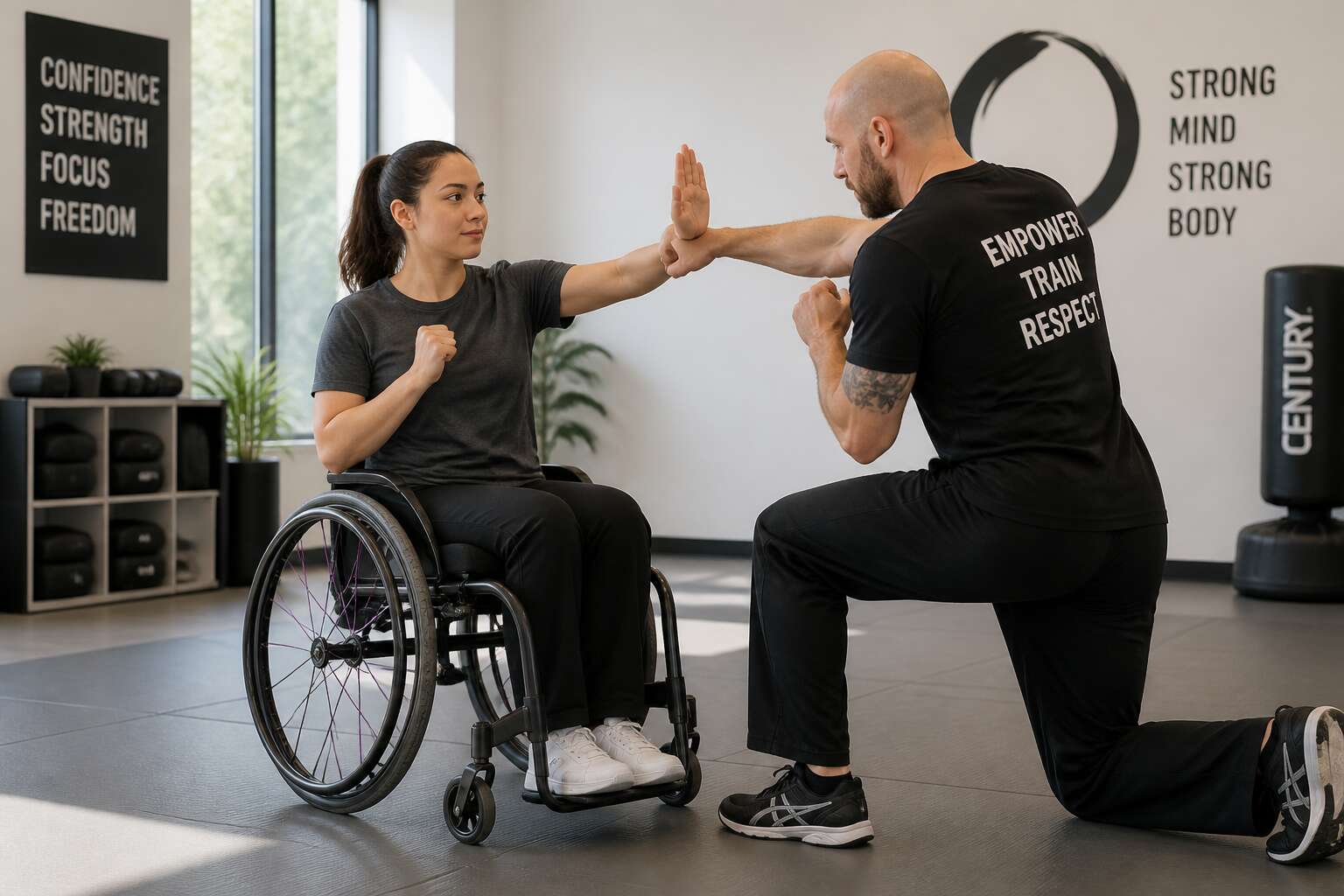
In South Africa, many wheelchair users discover that traditional self defence for disabled people relies on techniques built for a standing body. This leaves a critical gap. Your chair is a powerful tool, not a limitation. The objective is to turn your mobility equipment into a stable platform for protection, using mechanics that work with your centre of gravity.
Your upper body strength becomes your primary engine for adaptive self-defence. Every technique starts with efficient transfer of power from your shoulders and core. Effective methods focus on sharp, explosive movements that create immediate separation from a threat. Consider these core principles for your personal safety strategy:
– Forearm strikes that use the full length of your arm as a lever, rather than a simple push
– Palm-heel thrusts directed upward into the attacker’s chin or nose, powered by a quick hip shift
– Using the push rims to brace yourself, gaining leverage to deliver stronger, more stable hits
The chair itself provides a formidable shield. You can use the footplates to block an assailant’s approach, creating a necessary buffer zone. By gripping your wheels firmly, you can perform sharp pivot turns, spinning to deflect oncoming grabs. This active use of your equipment transforms a potential vulnerability into your greatest tactical advantage.
Positioning is equally important. Always angle your chair to present a smaller target profile, keeping your stronger arm facing the threat. Wheel control allows you to manage distance precisely, ensuring an attacker cannot easily access your back or sides. Effective self defence for disabled people in a chair is about making it physically difficult for an opponent to reach you, while maximizing the force you can generate from a seated position.
Verbal De-escalation Strategies
Around 70% of physical attacks begin with a verbal confrontation lasting under ten seconds. That window holds more value than most self defence for disabled people courses acknowledge. Your voice provides an early warning system and a boundary-setting instrument.
Effective verbal de-escalation relies on paralinguistic features rather than memorised phrases. Consider these tactics:
- Lower your pitch and slow your pace gradually
- Use the person’s name once, early, to personalise the interaction
- Ask closed-ended questions to shift focus from emotion to a concrete answer
These techniques calm the situation enough for you to leave or call for help. In South Africa, where response times vary, this verbal layer supports a broader self defence for disabled people strategy. I have seen it create the space needed to move away safely.
Using Mobility Aids as Tools
Consider your mobility aid as more than a support structure. It is a spatial awareness tool that extends your sensory reach and provides a protective boundary. In South Africa, uneven pavements and crowded spaces demand that you develop this awareness for personal safety. Self defence for disabled people often begins by controlling the distance between you and a potential threat.
A walking stick or cane offers a simple method to manage that space. Position it diagonally across your body, tip angled toward the ground. This stance creates a physical marker that discourages close approach. Some practitioners find these applications effective for self defence for disabled people:
– Use a firm grip to hook the cane around an attacker’s ankle and pull
– Thrust the rubber tip toward the shin or knee for a quick distraction
– Swing the cane in a wide arc to create temporary space, then move away
These movements require no upper body strength. They capitalise on leverage and surprise, giving you a few precious seconds to retreat. If you use crutches, your weight distribution changes the equation. Keep your elbows slightly bent and your centre of gravity low. A crutch can brace against a push or block a grab when held horizontally across the chest. Your aid is always within reach, which makes it one of the most practical tools for self defence for disabled people in everyday situations.
Ground-Based Defense for Limited Mobility
Each year, over 3,000 South Africans are admitted to hospitals for fall-related injuries, a figure that starkly illustrates the vulnerabilities of ground-based scenarios. Yet, self defence for disabled people demands a reassessment of this very positioning. When gravity dictates the encounter, the ground becomes a tactical foundation, not a deficit. The goal is to convert the floor’s resistance into an advantage, using friction and body weight to create precise, defensive outcomes.
The effectiveness of this approach relies on understanding pressure points accessible from a seated or reclined posture. These targets require minimal extension and maximum efficiency.
1. The instep, struck with the heel, breaks balance.
2. The lateral knee, kicked with the sole, compromises stability.
3. The shin, scraped with the boot edge, demands attention.
A common misconception is that being down equates to being out. For a person with limited mobility, however, the floor offers a lower centre of gravity and increased contact points with the ground. A swift, sharp kick to the adversary’s knee generates enough pain to create a window for escape. The commotion of a scuffle on pavements often draws the onlooker, a social action that we rely upon. Self defence for disabled people here is about exploiting specific anatomical vulnerabilities, not brute force. Your strength lies in the accuracy of a well-placed pivot and the solidity of a planted sole. Your shoe is your primary tool; a sturdy heel is a formidable ally against an aggressor’s foot. The strategy is to manage the immediate, painful impact, allowing you to reorganise and call for assistance. It is a grounded, practical approach for the woven realities of South African streets.
Self-Defense for Visual or Hearing Impairments
For a person with a visual impairment, the ears become the first line of defence. Footsteps, breathing, the scrape of a shoe on pavement, all of it forms a picture before contact ever happens. For a person with a hearing impairment, the eyes take that role, reading posture, pace, and intent from across a room.
Sensory substitution is not a workaround. It is a measurable advantage in close quarters. Visual impairment training pushes students to hold distance and time a response to the sound of an approach. Hearing impairment training relies on sight lines and on feeling the vibration of footsteps through the floor. These are physical inputs, not abstract ideas.
Self defence for disabled people here depends on space as much as sensation. Spatial memory maps exits, obstacles, and safe zones. The width of a doorway, the drag of a rug, the location of a solid wall, all of it becomes strategic information.
Empowerment Through Training
Finding Inclusive Self-Defense Classes
Most self defence instructors in South Africa have never adapted a class for a student with a spinal injury or a chronic pain condition. That gap leaves many people without options. Finding inclusive self defence for disabled people means moving beyond the standard dojo and searching for trainers who ask questions before they demonstrate.
A good class should feel like a collaboration, not a lecture. Look for these signs when you visit a potential training space:
– Instructors who discuss your specific mobility range openly
– Class sizes that allow for individual attention
– Facilities with accessible entry points and restrooms
– A policy that allows you to rest or adjust exercises without judgement
Training becomes empowering when the pace respects your body. One woman I know took three months to master a single wrist release. She now teaches that move to others. That is the real meaning of empowerment. It is not about mastering everything. It is about claiming the right to defend your own life, on your own terms.
Working With a Coach Who Understands Your Needs
Most self defence for disabled people fails in the dojo, not in the street, because instructors assume that slower means poorer. That is nonsense. A coach who actually understands your needs treats your body as a dataset, not as a problem to be solved.
They watch how you move. Then they wait for you to speak, and finally they adapt a technique so it fits your reality, not a textbook picture. That process builds confidence because it respects your baseline, not the trainer’s ego.
A good working relationship often looks like this:
– Training sessions that end with you having energy left over.
– Rehearsal of a skill until you feel bored, not overwhelmed.
– Honest feedback that never blames your body for a failed movement.
When a coach consistently prioritises your safety over their curriculum, you stop just surviving the session. You start practicing the art of refusal. That shift alone makes self defence for disabled people feel less like therapy and more like a proper skill worth owning.
Building Confidence Through Scenario-Based Practice
Scenario based practice turns uncertainty into a rehearsed response. You stand in a lift at Gateway Mall, a stranger steps close, and your body already knows the sequence. That is the power of simulation. It mirrors your daily commute, your taxi rank, your parking garage. Each drill maps a familiar route in your mind, so fear cannot freeze you.
Confidence emerges from repetition, not hope. For self defence for disabled people, this training bridges the gap between knowing and doing. You learn to read space, time your reaction, and trust your own judgement. The more scenarios you run, the more your brain files them as normal.
- Replay the same scene with different entry points.
- Change distance, lighting, noise.
- Debrief honestly after every attempt.
That process alters how you carry yourself in any self defence for disabled people training. You stop scanning for threats with panic. You scan with intention. When the real moment arrives, you are not hoping. You are prepared.
Online Resources and Virtual Training
In South Africa, the digital realm remains open when the physical dojo is out of reach. Virtual sessions stream into your home, where the only witness is your reflection. The screen does not judge your pace or posture. It repeats the sequence until movement becomes memory.
I have watched students train from bedrooms in Durban. Online resources for self defence for disabled people extend beyond static videos. Interactive platforms offer real time feedback, adaptive drills, and captions for the deaf. You can train at 2 a.m. or at dawn in a quiet Cape Town suburb. The connection falters; the instruction holds!
- Live classes led by instructors who understand disability
- Recorded libraries you can pause, rewind, and repeat
- Private sessions without the pressure of an audience
Virtual training erases the commute and the stairs. It places practice within reach of your hands and your schedule. That is quiet power.
Legal Considerations and Ethical Boundaries
Understanding Self-Defense Laws in Your Region
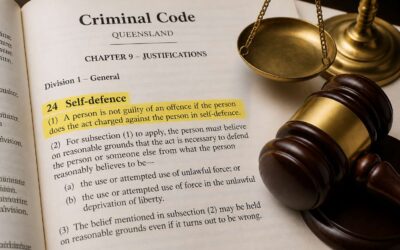
South Africa’s legal framework around self defence is as nuanced as it is demanding. The law requires your response to be proportionate to the threat, which creates a delicate balance for anyone with limited mobility or sensory impairments.
Understanding self defence laws in your region means knowing when force is justified, and equally, when it becomes excessive. Ethical boundaries extend beyond statutes; they live in the moment of decision. I have watched clients wrestle with this, because the law does not always account for physical differences.
- Reduce immediate danger before acting
- Document what happened accurately
- Keep your own safety as the priority
For self defence for disabled people, the burden of proof often feels heavier. You must show you acted reasonably, given your specific situation. That is why local legal counsel or a disability rights advocate is essential.
Proportional Force and Disability
Proportional force carries different meaning when your body moves differently. South African law asks what a reasonable person would do, but reasonableness must be measured against your actual capabilities. This is where legal self defence for disabled people becomes nuanced. You are not expected to match an able-bodied stranger’s response. You are expected to act within your own physical reality, provided that reality does not cross into retaliation.
The ethical boundary sits before the legal one. Ask three questions during an encounter:
- Is the threat immediate?
- Is my response the least force that stops it?
- Am I acting to escape or to punish?
Those answers shape how a court interprets your actions. Documentation and witness testimony matter. So does regional precedent. Self defence for disabled people requires knowing that reasonable force is not a fixed number. It shifts with your body, your environment, and the actions of the attacker.
Reporting Incidents and Documenting Evidence
The ethical boundary does not vanish when the threat ends. If your response crossed into punishment, paperwork cannot soften that. Self defence for disabled people demands a clear head in the aftermath. Adrenaline muddies recollection, so capture the moment while it is sharp.
Documentation starts with your body and your environment. Photograph injuries, torn clothing, and displaced objects. Write your account in your own words, noting the attacker’s posture and your exact movement. A list helps here:
- Note the time and location down to street level.
- Record any pain or physical limitation you experienced.
- List witnesses, even those who only overheard sounds.
Report to authorities as soon as your safety allows. In South Africa, the police will ask for your version of events. Medical records and your assistive device’s condition carry weight. Keep copies of everything. Witnesses disappear and memories fade, but documentation remains a stable anchor.
Interacting With Law Enforcement
When officers arrive, their first impression of your disability can shape the exchange. In South Africa, police protocols acknowledge disability, yet interpretations differ. Frame the conversation around your identity as a person who defended yourself, not as a victim and not as a suspect. Keep your hands visible and your assistive device within reach unless an officer directs otherwise.
Explain your physical limitations before you move. If you cannot stand, say so. If your speech is affected, point to written notes. The law requires reasonable accommodations under the Promotion of Equality and Prevention of Unfair Discrimination Act, but that alone will not protect you. A complete account holds three elements:
- Your identity as someone claiming self defence for disabled people.
- The immediate threat you faced.
- The exact response you made.
Self defence for disabled people receives extra scrutiny when law enforcement arrives. Officers may misread a flinch or a long pause.
Building a Personal Safety Plan
Creating an Emergency Contact Network
Building a personal safety plan starts with an honest inventory of your daily patterns. Your emergency contact network should reflect that same clarity. A short list of names is insufficient. Every contact needs a defined task during a crisis, such as checking on you or alerting someone who knows your location.
For self defence for disabled people, the plan must account for communication barriers and movement limits. I have seen how a shared signal, like a repeated text or a code word, can bridge the gap when verbal speech is impossible. The network thrives on rehearsal, not assumption.
Home Safety and Adaptive Security Devices
Your home should be a refuge, not a source of new problems. For self defence for disabled people, the physical layout matters long before a crisis. Consider the path from your bed to the front door. Is it clear? Can you reach a safe space quickly?
I have found that adaptive security devices do not have to be complicated. Smart plugs activate lamps on a schedule. Video doorbells provide a clear view without standing. Contact sensors chime when a door opens. These tools fold into a personal safety plan without demanding constant attention. Common household options include:
– Door viewers mounted at seated eye level
– Keyless entry systems requiring minimal grip strength
– Lighting that activates automatically at dusk and dawn
Each device should be tested with your specific movements, not an able-bodied expectation of what works. Your home should match your real needs.
Cultivating a Safety Mindset
Cultivating a safety mindset begins with understanding that self defence for disabled people is not a single response, but a daily orientation. It asks you to notice the rhythm of your surroundings, the exits, the people, the moments when you feel at ease or alert. This awareness is not paranoia. It is a quiet practice of attention, and it grows stronger with repetition.
Personally, I have found that a safety plan takes shape when you map your own patterns. It includes what you know about your energy levels, your triggers, your trusted contacts, and your escape routes. The plan is not a fixed document; it evolves as your body, environment, and relationships shift. What works during a good week may need adjustment on a difficult day, and that adjustment is part of the practice itself.
Leveraging Community Support
A personal safety plan gains strength when it rests on community support. In South Africa, many disabled people live with isolation. The neighbour who notices your routine, the shopkeeper who checks the street before you step out, the church group that calls when you are absent, can each play a role in your safety. Building that support takes clear communication. I have watched neighbours step forward.
For instance, a neighbour might step outside when you arrive home late. A community centre might offer a safe room during load shedding. A support group for disabled adults can share what works in your area. The plan then includes:
- People who observe and report unusual activity near your home.
- Spaces where you can go quickly if threatened.
- Trusted voices who can speak on your behalf in a crisis.
Self defence for disabled people is rarely a solo act. It works best when coordinated with your community.


0 Comments